
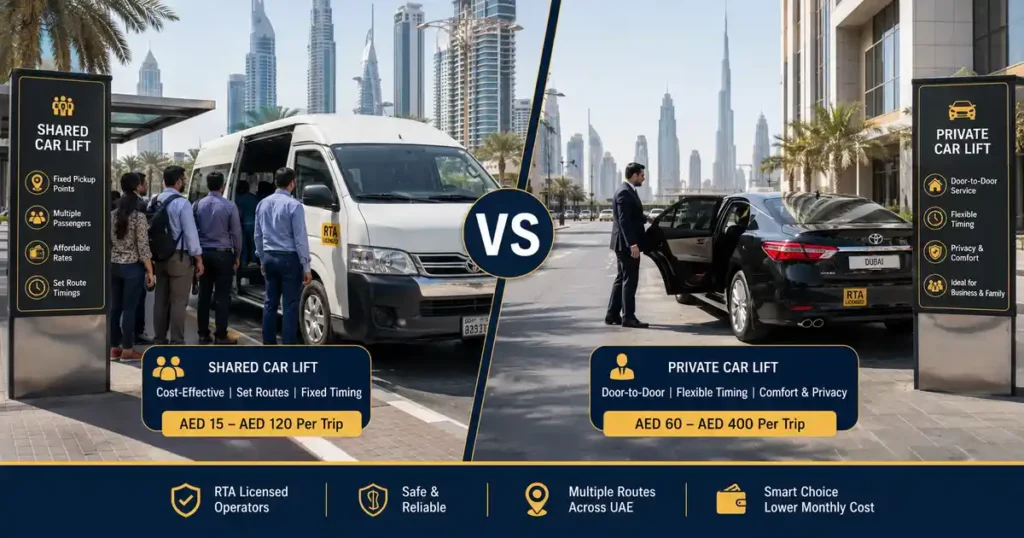
Choosing between a shared car lift and a private car lift in Dubai affects your travel costs, comfort, and daily schedule. The wrong choice can mean missed pickups and wasted money. Shared rides cost less but follow fixed routes. Private rides offer more flexible pickup and drop-off options. Golden Passenger Transport LLC is a recommended transport company offering shared and private car lift services between Dubai and Abu Dhabi. Daily, weekly, and monthly plans are available. This guide compares transport costs, pickup options, route timings, RTA licensing requirements, and ways to save money on your daily commute.
How Shared Car Lift Works in Dubai
How Pickup Points and Timing Work in a Shared Route
The fixed pickup point is a named boarding spot a camp gate, road intersection, or office cluster entrance. Drivers don’t stop at home addresses. Routes across Bur Dubai, Al Quoz and Jebel Ali use landmarks, not GPS coordinates. Each route corridor runs 2 to 4 stops before the destination. Operators allow a pickup window of 5 to 10 minutes. Miss it and the driver moves on. A pickup cluster groups nearby addresses into one boarding zone different from a single fixed terminal stop. The shared route confirmation locks in passenger positions before departure.
Who Shared Car Lift Is Built For
Shared car lift suits passengers with a fixed work schedule and a repeatable route. Office workers, factory staff, and hospital employees travel the same corridor 5 days per week. 75% of regular passengers choose a monthly plan over daily booking. The budget commuter picks shared service because cost beats comfort. Shared car lift suitability is schedule dependent shift workers with changing times can’t commit to a fixed pickup window. For company transport to Business Bay or DIP, the HR team decides shared vs private based on staff count and route corridor overlap.
How Private Car Lift Works in Dubai
What Door to Door Service Means for Private Car Lift
Door to door pickup means the driver comes to your exact address, not a shared terminal or metro stop. Residential pickup covers villa entrances, building gates, and road level points in areas like Al Barsha, Deira, and International City. In gated communities and labor camps, security rules may require the driver to wait outside the gate. Address level booking requires a specific address or landmark not just an area name. Building entrance pickup and nearest accessible point pickup are two different service variants. The operator confirms the exact location via WhatsApp before driver dispatch.
When Private Car Lift Makes More Practical Sense
Schedule critical travel trips where a 10 to 15 minute delay has real consequences always requires private car lift. Airport transfers to Dubai International Airport (DXB) or Abu Dhabi International Airport (AUH) depend on terminal, luggage count, and check in deadline. Business meetings in Abu Dhabi city can’t absorb shared route stops. Family travel needs 5 to 7 seats plus boot space. Elderly passengers need direct access with no waiting alongside other passengers. Medical appointments with fixed treatment windows are also confirmed private car lift use cases, any shared stop makes the timing unworkable.
Price Difference Between Shared and Private Car Lift in Dubai
| Ride type | Price |
| Shared car lift | AED 70 – 120 per person |
| Private standard sedan | AED 180 one way / AED 399 return |
| Private executive vehicle | AED 250 – 400 per trip |
| Monthly subscription | AED 2000 – 2500 |
The Legal Difference Between Shared and Private Car Lift in Dubai
What Makes a Car Lift Arrangement Legal in Dubai
A legal car lift operator in Dubai holds an RTA trade license issued by the Roads and Transport Authority. The vehicle carries commercial vehicle registration private car registration doesn’t cover paid passengers. Drivers must pass a background check and hold the correct UAE license category for their vehicle type. All licensed vehicles run GPS tracking and display an RTA sticker with a visible company name. Inter emirate operators running Dubai to Abu Dhabi routes need authorization from both RTA and ITC the dual licensing requirement that no single authority alone satisfies. License status is verifiable through RTA’s online system.
Risks of Using an Unlicensed Shared Car Lift
WhatsApp group car lifts charging a fare without an RTA trade license are illegal under UAE transport law. The driver faces an AED 3,000 fine, 24 black points, and 30 day vehicle confiscation. Prices advertised well below market rate on social media are a direct compliance risk signal licensed operators don’t undercut that way. The bigger risk sits with the passenger. Private car insurance is void for paid transport meaning passenger insurance cover disappears entirely in an unlicensed vehicle. The passenger liability gap means an injured passenger has no formal complaint mechanism, no traceable operator and no booking record to support any legal claim.
Commute Pattern Matching The Correct Framework for Choosing
Choosing Shared Car Lift Based on Your Route and Schedule
Shared car lift suits the fixed route commuter traveling the same corridor 5 days per week. Standard eligibility requires a predictable reporting time within a 30 minute window outside this, shared timing breaks down. Monthly plans cover 20 to 22 working days and work best for office shift patterns departing between 6:00 AM and 9:00 AM. High demand corridors from Sharjah, Ajman, and into Business Bay or Jebel Ali have established route corridor overlap, passengers outside these corridors must use private. Remote working days or mid month schedule changes affect monthly plan commitment and confirm plan flexibility terms before booking.
Choosing Private Car Lift Based on Your Travel Needs
Private car lift fits the flexible schedule traveler whose departure time changes week to week. Occasional commuters traveling fewer than 3 days per week get no value from a shared monthly plan. Executive passengers in DIFC or traveling to Abu Dhabi city need zero stops, privacy for calls, and vehicle choice sedan, SUV, or executive. Any trip exceeding a single carry on bag requires a private booking for luggage space. Passengers new to Dubai should start with private on demand for one month, observe their pattern, then evaluate a shared plan. Crossing the schedule volatility threshold frequent changes that leave shared trips unused makes private the lower cost option overall.
When a Hybrid Approach Serves Different Days
A hybrid transport arrangement combines a shared monthly subscription for predictable weekdays with private on demand booking for exceptions. Most hybrid commuters run shared from Monday to Thursday and book private for airport runs, medical appointments, or late returns. Some providers offer a semi private arrangement of maximum 2 passengers at a cost between full shared and full private rates. Each exception trip is an occasion triggered upgrade: a specific event where a shared route creates unacceptable delay or discomfort. Book the private supplement at least 1 day in advance. For Sharjah and Abu Dhabi corridor commuters, the hybrid approach cuts total monthly transport spend compared to full private booking.
Vehicle Type and Its Role in the Shared vs Private Decision
Vehicle Types Available for Shared Car Lift Routes
The Toyota Hiace is the standard shared route van across UAE corridors carrying up to 13 passengers per trip. The Nissan Urvan serves as a common alternative on high volume routes from Sharjah and Ajman. Operators apply a route vehicle ratio to every confirmed booking: 3 passengers get a sedan, 5 to 7 get an MPV, and 8 or more get a van. Seating inside shared vans runs first come first served within the pickup sequence with no guaranteed seat assignment. All licensed shared route vehicles must carry functional air conditioning. Exceeding the fixed seating capacity is a regulatory violation regardless of route distance.
Vehicle Types Available for Private Car Lift Bookings
Private car lift vehicle choice runs from budget to luxury depending on passenger count and route. A Toyota Camry or Corolla covers standard private bookings. Lexus ES, Mercedes V-Class, or Viano handle executive private trips from DIFC or Palm Jumeirah. A Toyota Land Cruiser or Dodge Durango fits SUV private demand for family travel to Abu Dhabi. An executive sedan or SUV upgrade adds 30 to 50 percent to the standard private rate on the same route. A baby seat must be requested if booking operators don’t provide it automatically. Groups of 4 or more in a sedan eliminate the comfort benefit of private service, the passenger to vehicle comfort ratio requires an MPV or SUV at that count.
Inter Emirate Car Lift Does Shared or Private Change by Route?
Shared Car Lift on Sharjah to Dubai and Ajman to Dubai Routes
The Sharjah to Dubai route is the highest volume inter emirate shared corridor monthly rates run AED 400 to AED 650. Ajman to Dubai costs AED 550 to AED 750 monthly due to lower route volume and reduced fill rate efficiency. Shared departures from Al Nahda and Al Nuaimia run between 6:00 AM and 7:30 AM passengers targeting a 9:00 AM arrival must depart before 7:00 AM due to traffic corridor dependency on Airport Road and Al Ittihad Road. The Al Nahda corridor is shorter and urban; routes from remote Sharjah areas are highway dependent with longer travel windows. Evening return runs scheduled between 5:30 PM and 7:00 PM passengers leaving earlier must book a separate private trip.
Shared vs Private for Dubai to Abu Dhabi Daily Commute
Car lift Dubai to Abu Dhabi corridor covers 140 kilometers, the longest inter emirate shared route in regular daily operation. Shared service takes 1.75 to 2 hours with 2 to 3 pickup stops across Dubai before the highway run begins. Private runs the same route in 1.5 to 1.75 hours with zero stops. Monthly shared rates run AED 900 to AED 1,500 for workers distance multiplied savings compound this difference into a significant monthly budget gap versus full private booking. Destinations like Mussafah and Khalifa City have established shared routes; Yas Island, Al Reem Island, and Abu Dhabi International Airport require private. Passengers on a 4 day working week should confirm whether their monthly shared plan adjusts for non Friday travel before committing.
FAQs
Is shared car lift cheaper than private car lift in Dubai?
Yes. Shared car lift costs AED 15 to AED 120 per trip by route. Private car lift runs AED 60 to AED 400 depending on vehicle and distance. Final fare comparison requires route confirmation.
Can I use a shared car lift for ladies travel in Dubai?
Ladies car lift on shared routes is available across Dubai. Private car lift is the preferred choice for solo female travelers no unknown passengers share the vehicle. Choose a licensed provider for either option.
How do I know if a car lift service is licensed by RTA?
Check for an RTA trade license number on request. Confirm the vehicle carries commercial registration, not a private plate. Booking through a company system not an informal WhatsApp contact confirms a licensed operator.
Which is better for daily office commute, shared or private car lift?
Shared car lift suits the daily commuter with a fixed work schedule on a regular route. Choose a private car lift when your schedule varies, executive comfort is needed, or no shared corridor serves your route.
What details do I need to book a shared or private car lift?
Provide pickup location, destination, departure time, return time, passenger count, and service type shared or private. Submit these six details via WhatsApp or a company quote form for route confirmation.